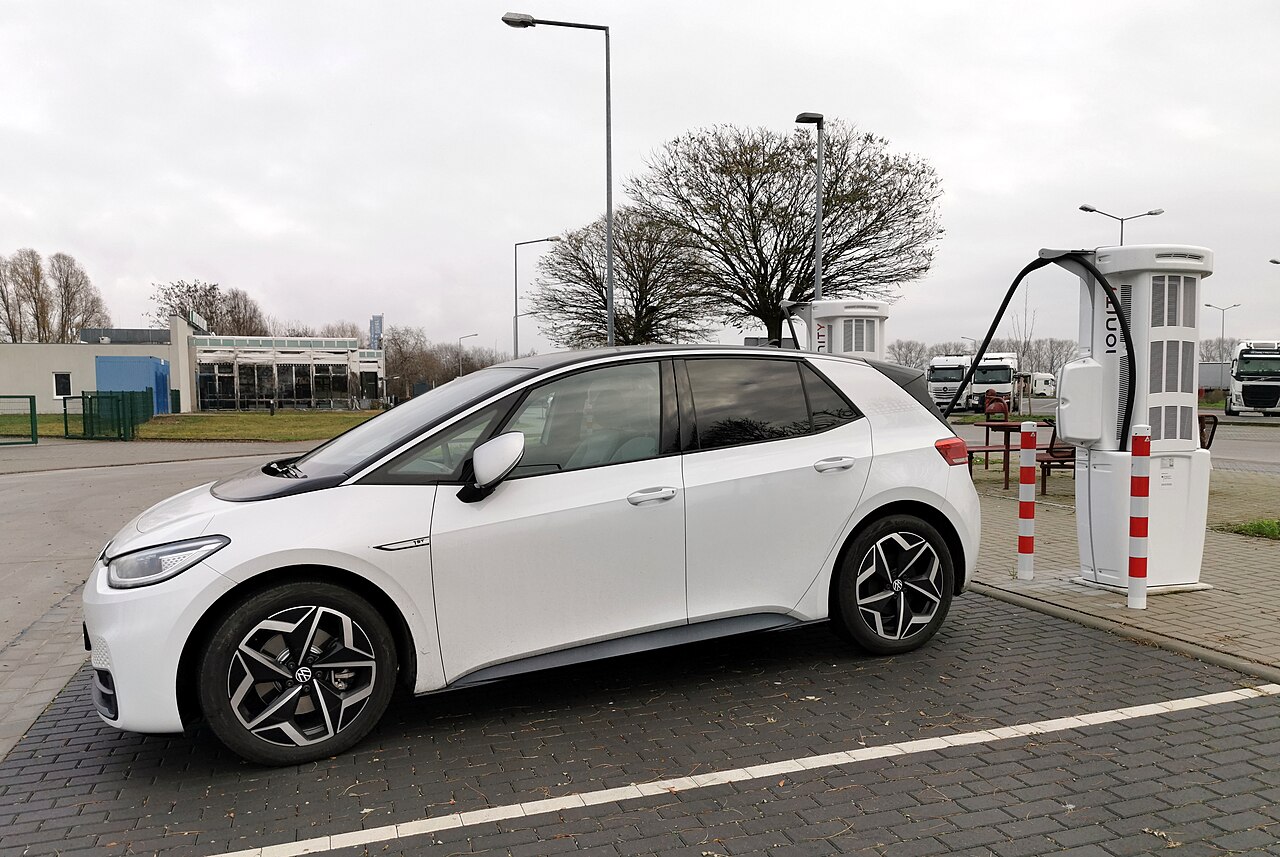
Rapid chargers at motorway stops are what make long-distance EV travel workable. Peter Kersten · CC BY-SA 4.0 · Wikimedia Commons
Tesla Supercharger is pan-european, high (150-250 kw). This is a map of the landscape, not a score — operator profiles are qualitative, and inventing a numeric rating to rank them against each other would be false precision of exactly the kind this site exists to avoid. Operator profiles in data/charging-networks.mjs — 14 operators.
Character
The largest and longest-established rapid network in Europe, progressively opened to non-Tesla vehicles.
Where it is strong
Very high stall counts and the best-regarded reliability record in the industry. Research into public charging user experience consistently finds availability and successful session start dominate satisfaction, ahead of raw power [1][2].
What to watch for
Not every site is open to other brands, and access for non-Tesla drivers generally requires the Tesla app rather than a card.
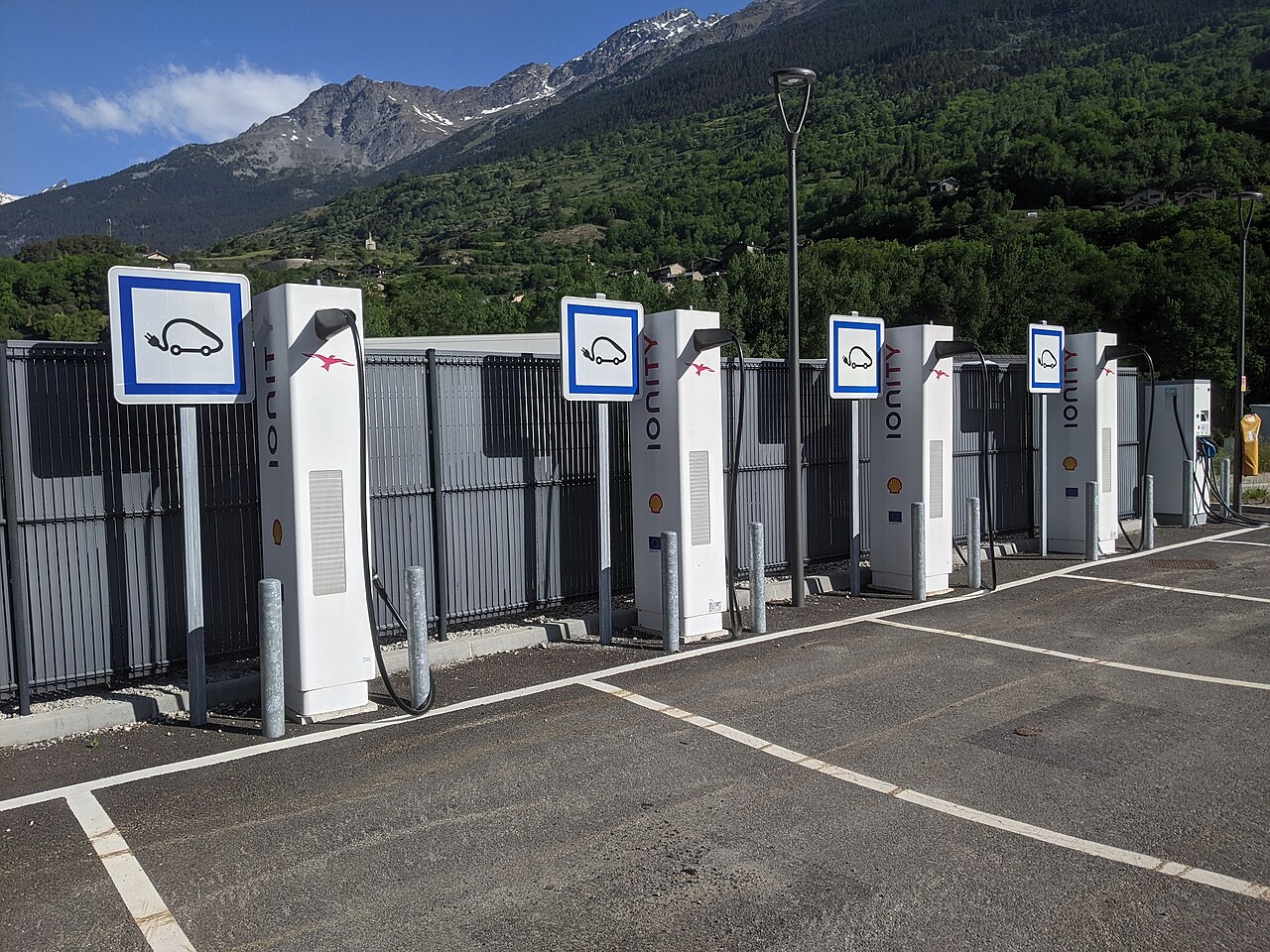
CCS is Type 2 with two DC pins bolted underneath. That is why the connector is never your problem anywhere in Europe: your car's socket accepts both, the top half is identical, and a rapid charger simply uses the extra pins. What differs at a border is payment, not the plug. Drawn to relative scale; pin arrangement follows IEC 62196-2.Chargers at the Fréjus tunnel approach serve traffic crossing into Italy. Sebleouf · CC BY-SA 4.0 · Wikimedia Commons
Why there is no price here
A charging session involves the operator, your mobility service provider and any roaming platform between them, each taking a margin. The same physical charger can therefore bill you three different amounts depending on whether you tapped a bank card, used the operator app, or presented a third-party roaming card. Those tariffs also change several times a year and differ by country.
Publishing a figure here would be wrong within months and misleading immediately. Check the current price in the operator app before you plug in — and if it bills per minute rather than per kilowatt-hour, remember that a cold pack or a high state of charge means you pay for the taper.
Where does Tesla Supercharger operate?
Pan-European. Coverage within that is uneven, so check your specific route rather than assuming national coverage.
How fast is Tesla Supercharger?
High (up to 250 kW). What you actually get depends on your car, the state of charge and the pack temperature as much as on the charger.
How much does it cost?
We deliberately do not publish tariffs — they change too often to be safe in a static page. Check the operator app before plugging in.
Will my roaming card work?
It depends on the agreement between your provider and this operator in that country. Carry a second card from a different provider.
References
Every citation below links to the original peer-reviewed record on PubMed or via DOI. Nothing here is a substitute for medical advice.
Electric Vehicle User Behavior: An Analysis of Charging Station Utilization in CanadaJonas T, Daniels N, Macht G · Energies · 2023 · Journal articleDOI
Resilience of urban public electric vehicle charging infrastructure to floodingRaman G, Raman G, Peng J · Nature Communications · 2022 · Journal articleDOI
Innovative Application of the Public–Private Partnership Model to the Electric Vehicle Charging Infrastructure in ChinaYang T, Long R, Li W, et al. · Sustainability · 2016 · Journal articleDOI
User Experience of Public Electric Vehicle Charging Infrastructure in Shanghai: A Quantitative AnalysisXie X, Raval S, Deb S · World Electric Vehicle Journal · 2026 · Journal articleDOI
Interpretable Station-Level Charging Congestion Pressure Assessment and Multi-Horizon Early Warning for Electric-Vehicle Charging InfrastructureShi K · World Electric Vehicle Journal · 2026 · Journal articleDOI
City-Scale Optimization of Public Electric Vehicle Charging Infrastructure: Spatio-Temporal Demand Forecasting, Graph Learning and Multi-Objective SitingThango B, Ayetor G · World Electric Vehicle Journal · 2026 · Journal articleDOI
Cost and Availability Optimization for Electric Vehicle Charging Infrastructure via Redundancy‐Spares‐Repair IntegrationNajdawi F, Fainman E, Jin T · Quality and Reliability Engineering International · 2025 · Journal articleDOI
Optimal Planning for Public Charging Infrastructure by Behaviour‐Based Electric Vehicle Charging Demand Simulations and Geographic Information SystemSirisumrannukul S, Prakobkaew P, Piamvilai N · IET Smart Grid · 2025 · Journal articleDOI

.jpg)